Director Carl Cote presented a Kimley-Horn study on reducing residential road speed limits from 30 to 25 mph.
Key findings: residential roads met the 85th-percentile criteria for a 25 mph reduction while collectors did not; implementation would require approximately 2,400 new signs at an estimated cost of $550,000–$1.3 million.
Council discussed concerns about cost-effectiveness given limited accident data on residential streets, the sheriff's 5-mph enforcement threshold, and the preference for targeting crosswalks and high-risk intersections instead.
Council reached consensus to pursue TPO and federal grants for funding rather than committing existing budget funds, and to continue the traffic calming device program.
Three members of the public spoke during the item's comment period.
Charter compliance concerns: alleges a $330 million bond was approved without required voter approval under charter Section 3E; that a council seat vacancy was filled by appointment rather than special election or ballot; that mayor vacancy language was altered in the charter without voter-approved ballot; requests written clarification within 3 days and that the charter review be tabled until the 2028 election.
Code enforcement concerns: relays a report from a resident who alleges code enforcement began frequent visits to their property after they commented critically on the city's Facebook page, and that they were singled out to replace a culvert while others on the same block were not; raises his own prior experience of 11 city workers and a sheriff's deputy appearing at his home without explanation; asks what safeguards exist for consistent code enforcement and accurate public records.
Council appointed seven individuals to the Parks and Recreation Advisory Board through a combination of paper ballot votes and voice votes by district.
Appointed: Megan Rizzo (District 1, uncontested), Ms.
Lightfoot (District 2, 3 votes), John Subers (District 3, 3 votes), Philip McLure (District 4, 3 votes), Julia Walthall (At-Large, 4 votes), Kelsey McManus and Diana O'Flaherty (Alternates, 5 and 4 votes respectively).
First meeting planned for April.
Ordinance 2026-XX to rezone 56 Hargrove Grade (10.44 acres, owned by Hard Rock Materials) from IND-1 to IND-2 to permit a ready-mix concrete batch plant.
Staff recommended approval; the planning board voted 5-2 in favor.
Applicant Hard Rock Materials gave an extensive presentation including a facility walkthrough video, economic impact analysis, air quality expert testimony, and a set of voluntarily proffered restrictive covenants covering trip counts, truck weight, water usage, fuel storage, and enforcement rights.
Numerous Hargrove Industrial Park business owners spoke in opposition citing road conditions, compatibility concerns, dust, and precedent from the prior council denial of a similar application at 11 Hargrove Lane.
On first reading, the motion to approve failed 4-1.
56 Hargrove Grade rezoning: raises traffic impact concerns including road condition, the road evaluation study covering only the US-1/Hargrove intersection and not the road itself, the distinction between trip counts and actual truck movement patterns, and the gap between the 200-trip cap and the 708 trips that current IND-1 zoning could theoretically support; requests the full traffic study be made publicly available.
56 Hargrove Grade rezoning: opposes the rezoning on grounds of cement dust health and environmental impacts; disputes the video demonstration of muriatic acid and cement powder as unrepresentative of conditions near Sunbelt Chemicals; raises water usage concerns citing nearly 9 million gallons per year from an already-strained aquifer; argues the park was developed as IND-1 for a reason.
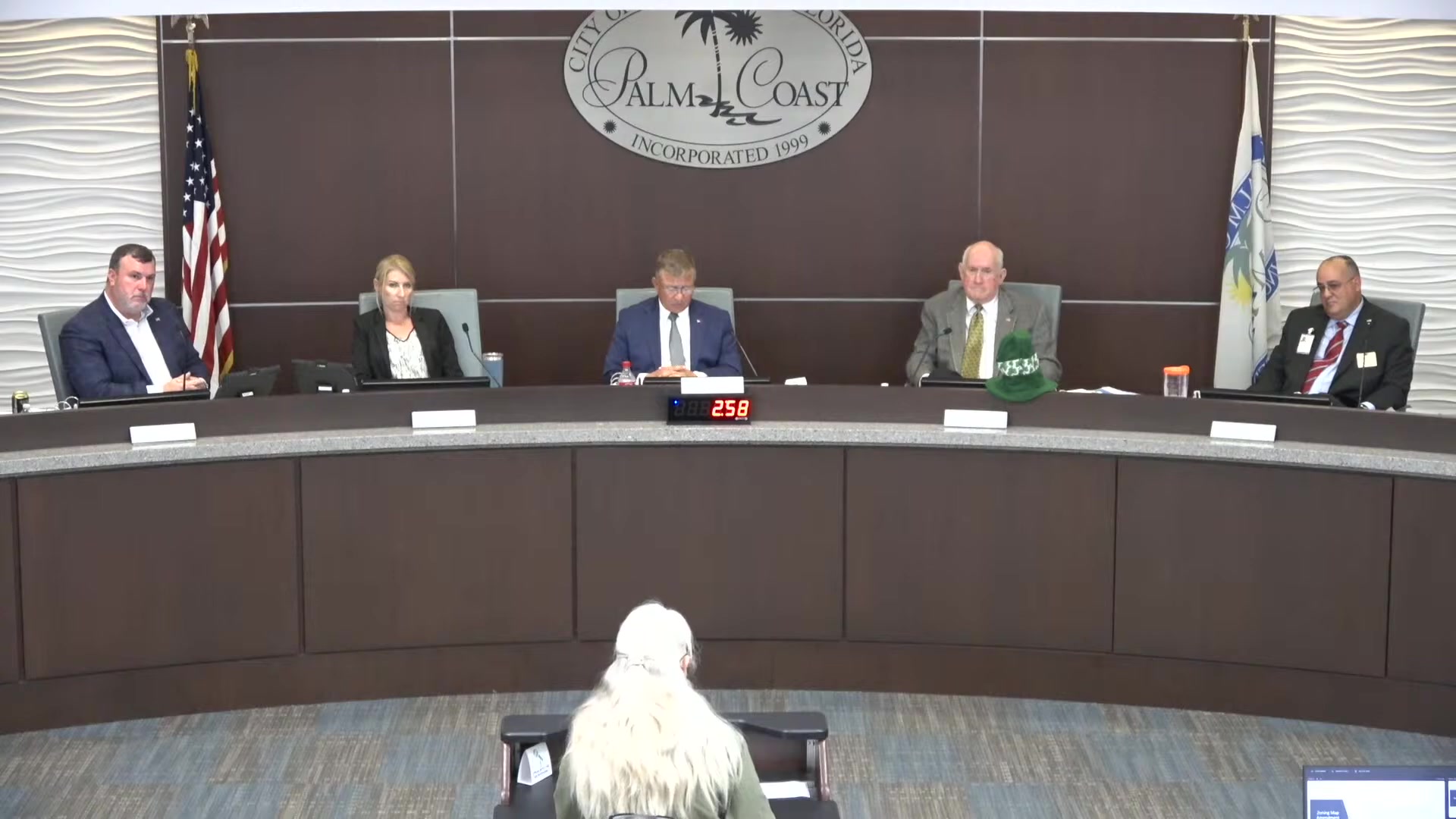
56 Hargrove Grade rezoning: opposes the rezoning; states the video used a wet slab and showed cracks; argues 15 jobs do not offset community impacts; contends data centers and batch plants both strain water supply; says Palm Coast should 'build classy not trashy'; opposes IND-2 use in this location.
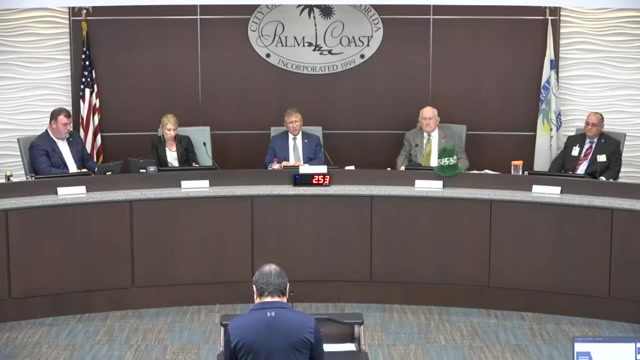
56 Hargrove Grade rezoning: opposes the rezoning; as owner of Auto Haus of Palm Coast on Hargrove, raises concerns about increased congestion and safety risks for customers and employees, road deterioration from heavy trucks, and the danger of accidents blocking the single egress point from the industrial park.
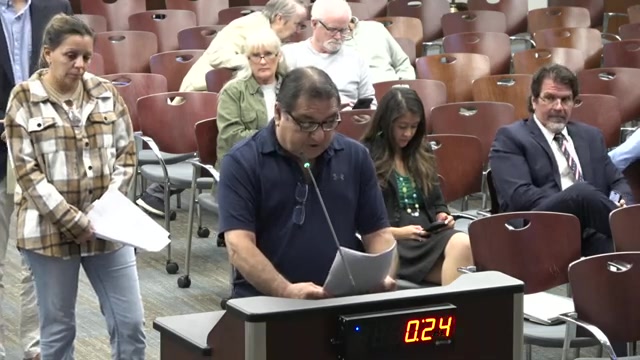
56 Hargrove Grade rezoning: opposes the rezoning as owner of property at 11 Hargrove Lane (15 Hargrove LLC); states their prior similar application was denied by council and they pivoted to a luxury car condominium project in reliance on that denial; argues approving this application for materially similar use would be legally inconsistent and could expose the city to a damages claim; asks council to maintain consistency with its prior decision.
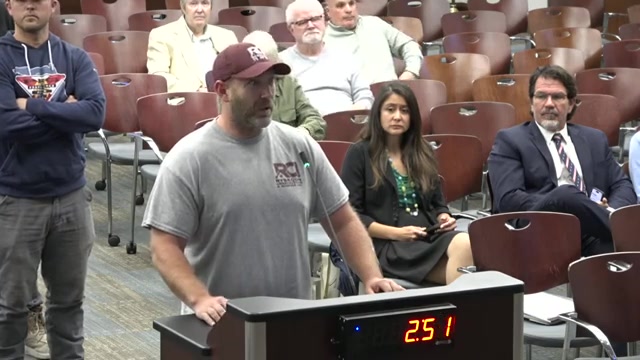
56 Hargrove Grade rezoning: opposes the rezoning; as owner of property at 2 Market Place on Hargrove, raises concerns about trip delays for employees and clients and safety at the US-1/Hargrove intersection; acknowledges Hard Rock is a good company but calls it the wrong location; suggests they consider a site west of the tracks with alternate US-1 access.
56 Hargrove Grade rezoning: supports the rezoning as a Hard Rock Materials employee and Palm Coast resident; notes the plant will supply concrete locally for roads, schools, and homes; describes the company's safety record and operations; asks council to support the project.
56 Hargrove Grade rezoning: supports the rezoning as a Hard Rock Materials employee who commutes 100 miles daily from Palm Coast to St.
Augustine; notes growth creates jobs and benefits the local economy; states he has worked with concrete for 15 years and has not experienced adverse air quality effects despite having asthma.
56 Hargrove Grade rezoning: supports the rezoning as a recent Hard Rock employee who relocated from Colorado; notes the company's dedication to employees and community; supports the economic benefit of having a local job rather than commuting.
56 Hargrove Grade rezoning: supports the rezoning as a Palm Coast resident and Hard Rock employee hired two years ago; argues approving is the responsible choice given existing IND-1 permitted uses could generate more intensive traffic; notes covenant restrictions limit the project's impact below what current zoning allows; cites job quality and median income alignment.
56 Hargrove Grade rezoning: supports the rezoning as a long-time Palm Coast resident and Hard Rock employee; describes difference between Hard Rock's organized operations and prior employer Cemex; argues concrete is essential to the community's growth.
56 Hargrove Grade rezoning: opposes the rezoning as owner of Major Auto Repair on Hargrove; raises concern about the single egress point being blocked by concrete trucks and the impact on 70+ businesses and hundreds of employees; states clients with nice cars will not want rock chips; argues the road is not designed for these trucks.
56 Hargrove Grade rezoning: supports the rezoning as a Hard Rock Materials representative; notes trucks are currently in the parking lot having come from jobs in Palm Coast that morning; states their concerns have been addressed factually and asks council to decide based on facts not fears.
56 Hargrove Grade rezoning: opposes the rezoning as a new business owner at 15 Old Grove Lane; questions the financial return of 15 jobs and $40,000 in tax revenue against the projected community impacts; supports the Vice Mayor's snowball effect concern about IND-2 expansion in the park.
56 Hargrove Grade rezoning: opposes the rezoning as a 20-year Palm Coast resident and business owner in the Hargrove Industrial Park; argues this is a precedent-setting decision that contradicts the prior council denial; contends IND-2 uses are incompatible with existing light industrial businesses; states his family's planned $1.5 million expansion of their property is now in jeopardy if the batch plant is approved; warns the trucks, dust, and precedent will come.
56 Hargrove Grade rezoning: speaks as a board member of the Palm Coast Commercial Industrial Center at Hargrove Lane 15, representing multiple small business owners; describes the diverse businesses in the park (carpenters, AC companies, electricians, auto mechanics, a baker, a church); argues the park developed under a clear IND-1 framework and that this rezoning would fundamentally change its character and harm businesses that invested based on zoning expectations.
Resolution accepting the FY2025 Annual Comprehensive Financial Report as presented by Mauldin & Jenkins, LLC.
Audit partner Daniel Anderson presented: unmodified (clean) opinion, no findings or recommendations, no federal or state single audit findings, full cooperation from management.
This was Mauldin & Jenkins' first year as city auditor.
Council members praised both the auditing firm and finance staff.
FY2025 Annual Comprehensive Financial Report: expresses appreciation for a new auditor but argues an external forensic audit of the city — particularly utilities — is still needed; characterizes the current process as internal rather than truly external audit.
Resolution approving a construction contract with PBM Constructors, Inc. for WTP #1 Wellfield Expansion (equipping wells SW-147 and SW-148 and installing approximately 2,000 feet of new raw water main).
Seven bids received; lowest bid of approximately $1.1 million came in under the engineer's estimate of $1.3 million.
Project funded through capital; originally two separate capital line items, combined for efficiency.
WTP #1 Wellfield Expansion contract: describes a July 2025 tour of water treatment plants given by staff member Pete Rosselle; states she was shown a large map of all city wells and told there are many more wells than publicly acknowledged; argues the city does not have a well or capacity problem but a waste problem; questions whether the two new wells being approved already exist.
Resolution approving expenses for the 2 Utility Drive Modifications Project.
Staff originally proposed $1.675 million ($1.5 million upfront plus $175,000/year lease for temporary modular office facilities to replace the aging main administration building).
After council discussion about purchase vs. lease economics and potential reuse of purchased buildings for future city needs including an animal shelter, council amended the approach and approved up to $2.5 million for purchase of the modular buildings rather than leasing them, with funds drawn from the utility fund's mock transfer allocation.
2 Utility Drive modifications: characterizes the project as reflecting utility management failures and calls the $2.5 million expenditure outrageous; suggests the city should sell the property, keep staff dispersed, and use space at existing facilities with low-cost partitions instead.
Resolution repealing Resolution 2025-41 vacating certain streets in Palm Coast Park — necessitated because FPL easements were found after the original vacation that required proper notice.
Repealing allows a corrected vacation to proceed.
Resolution designating an administrative authority to receive, review, and process plats and replats.
Mayor Norris noted his desire to continue receiving council-level visibility into administratively approved plats given growth concerns.
Resolution approving vacation of certain streets in Palm Coast Park (Tracts 18 and 20) — the corrected vacation following repeal of the prior resolution, ensuring FPL easements are not disturbed.
Resolution approving a right-of-way map for the Matanzas Westward Expansion Project, formalizing the road alignment west of the railroad tracks to enable utility corridors and future development infrastructure.
Consent agenda (Matanzas Westward Expansion): raises concerns about the Westward Expansion road project and asks what infrastructure was received from the developer as part of the $115 million road investment and whether citizen funds are being used instead of developer funds.
Resolution approving submission of a Florida Inland Navigation District (FIND) Waterways Assistance Program application for design services for the acquired waterfront property.
Staff clarified the grant is up to 50% match and the scope and acceptance of funds will be determined after award notification in October.
Charter matters (at adjournment): presents copies of official ballot samples and asks the city attorney to identify where the ballots authorized removing the mandatory special election language for mayor vacancies or substituting it with vice mayor succession; accuses the attorney of reciting altered charter language to the charter review committee.
Residential speed limit reduction study: agrees with focusing on crosswalks, sidewalks, and grant funding rather than citywide sign replacement; asks whether rumble strip reflectors were studied as a lower-cost traffic calming option.
Residential speed limit reduction: questions whether the cost of 2,300+ signs is justified given that people are already driving below 30 mph; argues speed limit changes only work when road design and enforcement support them; urges clear data before committing funds.
Residential speed limit reduction: opposes the expense and questions whether signs will change driver behavior; raises concerns about sign placement in front yards and impact on property values and neighborhood aesthetics; suggests relying on sheriff enforcement instead.
Residential speed limit reduction: expresses strong support for action, citing personal experience of children walking half a mile in the street to a bus stop in the dark; notes prior studies documented speeds above the posted limit; suggests reducing back streets to 20 mph and points out pedestrians are legally required to walk on the shoulder which is often impassable.