Westward Expansion / The Tax District: The Law and the Numbers
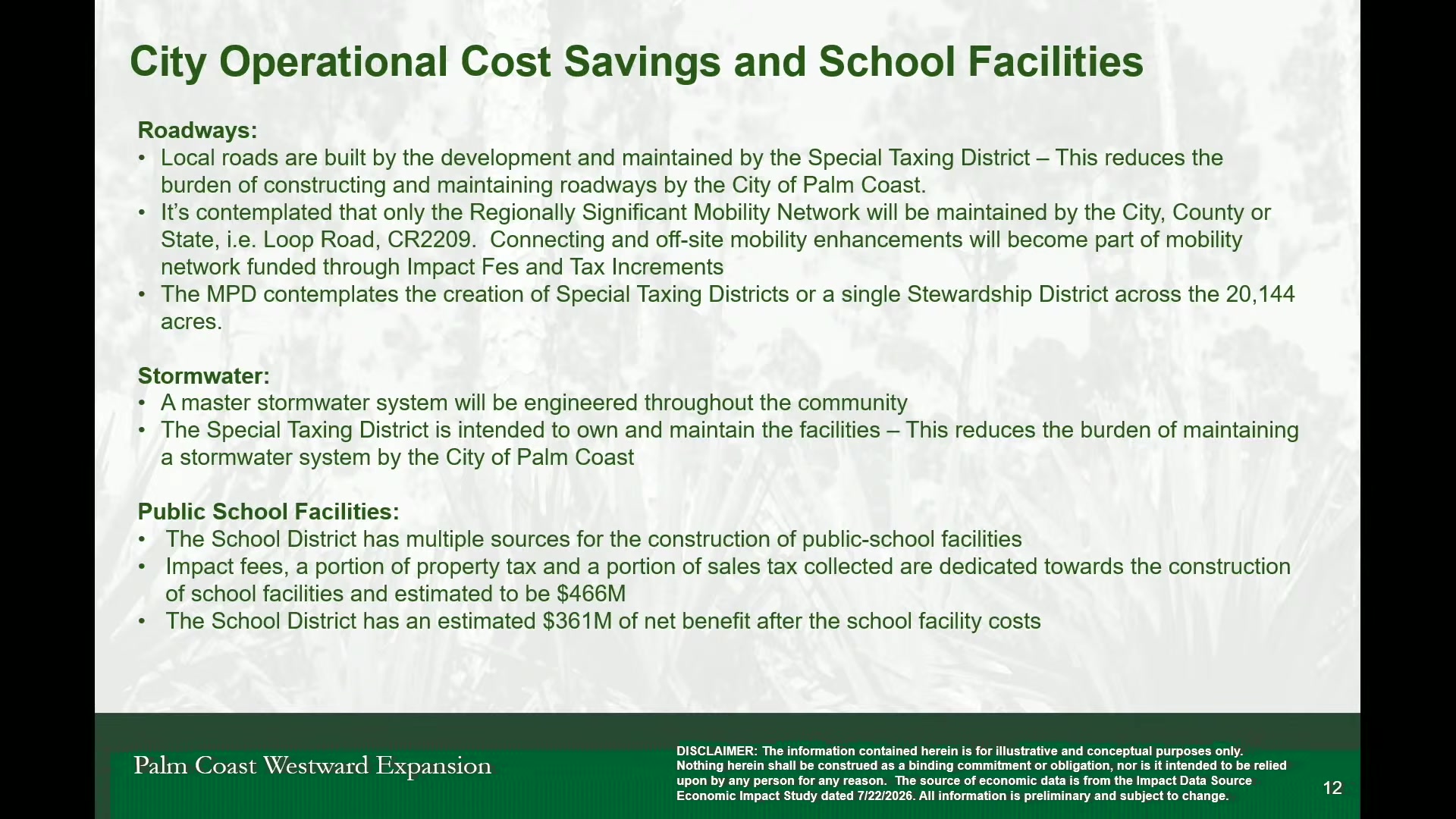
The question this investigation has returned to since it began is not whether the westward expansion will be built. It is who pays to build it. answered that question in dollar figures and deadlines. The Master Planned Development agreement that replaced them answers it by deferring six separate agreements — the utility agreement, water, sewer, the roads themselves, concurrency, and the Flagler County School District’s separate sign-off — to negotiations that have not occurred.
On August 4, 2026, under questioning from City Council, the applicant’s team named a mechanism. Infrastructure in the westward expansion would be maintained by a special taxing district, clarified in the same exchange as a stewardship district.
The instrument does not appear in the document before Council. The contains no reference to a stewardship district, a special district, or a taxing district of any kind. It exists, as of this writing, in a verbal answer given at a public meeting.
What a stewardship district is
A stewardship district is a unit of local government, legally distinct from the City of Palm Coast, organized under . Its general and special powers are typically drawn from the same uniform charter provisions at Sections 190.006–190.041 that govern Community Development Districts.
The distinction between the two is the manner of creation. A CDD is created by local government approval — a city or county ordinance. A stewardship district requires an act of the Florida Legislature, published as its own chapter in the Laws of Florida. As of this writing, no bill number and no draft special act creating such a district for the westward expansion has been located.
The taxing authority is where the structures diverge from ordinary municipal finance. Ad valorem taxation by a special district requires both an elected board of qualified electors and a public referendum, under Article VII, Section 9 of the Florida Constitution. Non-ad-valorem special assessments — operations, maintenance, and debt service — require neither. They are levied by the district’s board and collected on the county tax bill under the uniform method at Section 197.3632, Florida Statutes, in addition to city, county, and school property taxes rather than in place of any of them.
Who governs it
In the existing districts organized on this model, the governing board is elected by landowners, on the basis of one vote per acre, before it transitions to election by resident electors. The exact terms of that transition are set by each district’s enabling act. No enabling act exists here to examine.
The property at issue is 20,144 acres.
What it changes
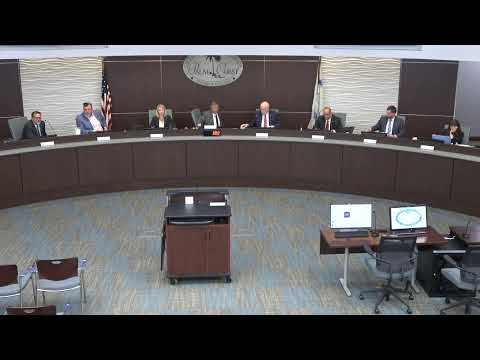
Council did not delay the westward expansion on August 4. It referred the Future Land Use Map amendment and the MPD zoning and development agreement — items G.4 and G.5 — to a special called meeting on August 25, 2026, with direction that staff bring Flagler County and the school district into the discussion beforehand. That is a compressed timeline, not an open-ended deferral. The six deferred agreements have not been taken up.
A stewardship district, if the Legislature creates one, would be a party those negotiations do not currently include. It would hold assessment authority the City does not control, a board the City does not appoint, and obligations defined by an enabling act not yet drafted. Section 7(m) of the MPD agreement requires the Landowner to negotiate a utility agreement with the City, subject to Council approval, and contemplates that the Landowner may not be the party to that agreement — in which case the other party must obtain written landowner consent before negotiations begin.
The precedent the applicant cited
The applicant’s team pointed to its own Nassau County community as the working model. Wildlight, near Yulee, sits within the East Nassau Community Planning Area and is governed by the East Nassau Stewardship District, created by Chapter 2017-206, Laws of Florida, and signed June 6, 2017. The developer is Raydient Places + Properties LLC. The westward expansion applicant is Raydient Palm Coast LLC, a Delaware limited liability company, named in the signed MPD agreement.
Raydient and affiliated Rayonier entities sued Nassau County beginning in November 2018, in litigation that ran more than five years and touched several distinct claims: public-records and Sunshine Law violations by county officials, an alleged breach of fiduciary duty by the county attorney, and whether the county’s tax designation for the development area was retaliatory. A settlement reported in February 2023 resolved the claims tied to the county attorney’s conduct. The question of who is responsible for park construction and maintenance — whether the county, Raydient, or the stewardship district itself bears that obligation — was decided separately. A Fourth Judicial Circuit ruling reported in April 2024 found that creating the stewardship district did not relieve Nassau County of its own service obligations for parks under the county’s Comprehensive Plan.
That holding addresses the precise question Palm Coast is negotiating. The existence of a district does not, by itself, move a host government’s obligations off the host government’s books.
What residents of that district pay
The East Nassau Stewardship District’s adopted budget for fiscal year 2026 sets out what each on-roll household in Wildlight Village Phase 1 pays the district — general fund, operations and maintenance, and debt service combined. A thirty-foot lot pays $896.08 per year. A seventy-foot lot pays $2,021.06. Later phases, carrying newer bond series, run higher.
These are not HOA dues, which Wildlight residents pay separately to a private entity. They are a special-district levy appearing on the county tax bill. They rise on a fixed amortization schedule — the Series 2018 bonds run through 2049 — which is to say they track the debt rather than the value of the home or the income of its owner.
The buyer the study assumes
The applicant’s economic impact analysis, prepared by Impact DataSource and dated June 23, 2026, is marked “DRAFT — FOR REVIEW PURPOSES ONLY” on every page. This outlet has examined its capital cost methodology elsewhere. On the question of who the single-family housing is designed for, the study answers directly and is taken here at its word.
It assumes a development cost and taxable value of $350,000 per single-family unit, and a buyer household income of $103,000 — stated by the study as twenty-five percent above the Flagler County median, by design.
Applied to that price at twenty percent down and a 6.76 percent rate quoted August 5, 2026, principal and interest run $1,818 monthly. Property tax at Palm Coast’s blended effective rate adds $300 to $375. Homeowner’s insurance in the 2026 Florida range adds $350 to $700. The total, before any district assessment or HOA charge whatever, is $2,468 to $2,893.
At the conventional twenty-eight percent front-end guideline, a $103,000 household carries $2,403. The stack clears that figure at its low end and exceeds it throughout, with no Wildlight figure included in the calculation.
What remains open
The agreements that determine what this development costs the public — the utility agreement, water, sewer, the roads, concurrency, and the school district’s sign-off — have not been drafted, negotiated, or scheduled. Sixteen years after the first development order, the terms remain to be written.
What is established is the framework such a district would be organized under, the terms on which an existing district by the same developer levies against its residents, and a circuit court holding that the existence of that district did not relieve its host county of the county’s own obligations. The parties return on August 25.
Full statutory citations: Chapter 189 and Sections 190.006–190.041, Florida Statutes; Article VII, Section 9, Florida Constitution; the assessment-collection mechanism at Section 197.3632. Five comparable enabling acts for structural comparison. Background research, PalmCoastStorylines.com.
Full litigation history, the district’s financial structure, and the complete FY2026 assessment table by lot type and bond series. Background research, PalmCoastStorylines.com.
The full stacked monthly cost model, every input shown and sourced, plus the complete FY2026 East Nassau Stewardship District assessment table by phase as an appendix. Background research, PalmCoastStorylines.com.