DRI / MPD: What’s the Diff?
In episode 1 of this series, we saw how during a massive re-write of the Palm Coast Comprehensive Plan while suspicions swirled that the whole thing was a scam.
As then-Mayoral candidate (now Mayor) Mike Norris said about the transition, “…it’s all about the money and making it available for the developers to build what they want on the west side.”
So what did the transition do? What’s the diff?
Back in the day, a DRI wasn’t just permission to build houses. It was a blueprint for a whole community — and the state made sure nothing got left off the page. Roads, schools, fire stations, parks, clean water — all of it had to be spelled out and actually paid for before the first family moved in, not promised for someday. And it wasn’t the developer’s word you had to take for it — the state and the regional planning council checked in on the project every two years, for as long as it took to finish.
It wasn’t a handshake, it was spelled out condition by condition. The Old Brick Township (OBT) DRI alone runs 39 numbered conditions. Water supply. Groundwater protection. Wastewater. Stormwater. Water quality monitoring. Solid waste. Transportation. Air quality. Low-impact development. Police and fire protection. Recreation and open space. Education. Workforce housing. Historical and archaeological sites. Silviculture. The community development district. Firewise protection. Seventeen separate boxes, and the developer had to check every one of them before the state would sign off.
An MPD is different. It’s an agreement between the city and the landowner, worked out at the negotiating table — overseen by staff, not by the state or a regional board. What gets built, and when, is however the city and the landowner agreed to it. Water and sewer aren’t promised before people move in — the agreement just says they’ll work that out later. And “later” doesn’t come with a deadline.
That’s what this transition did: swapped a highly structured plan — binding financial commitments, outside oversight — for hundreds of pages of 30,000-foot views and allocation matrices, with everything that actually matters marked “TBD.” What’s left isn’t a development plan. It’s permission to start building rooftops, with every real detail pushed off to be worked out later — less an agreement than an opening negotiating position.
On July 15, the Planning Board took the first action on Westward Expansion and they didn’t like what they saw.
The county’s attorney, Sarah Smechter, told the board she’d gone looking for language that used to be in an earlier draft of this agreement — protections tied to Old Brick Road — and found nothing. “It’s completely silent,” she said.
The county’s attorney, Sarah Smechter, added that the school board shares her concern. What’s in front of the board, she said, is “essentially an agreement to agree. Once you agree here, it cuts everyone else out.”
Even a board member said the city has this backwards. “It seems like we should front-load the industrial and commercial,” he said. “I mean, we’re currently, we’re long on residential and quite short on commercial and industrial here in the city.”
And when a board member pressed the applicant on what actually happens to land set aside for industrial and commercial use, the answer wasn’t reassuring. “So you’re saying it’s set aside, but there’s no requirement that you have to build it… there’s nothing that states that you have to stop building residential,” the board member said. “Correct,” the applicant answered. Could that land later get rezoned back to housing? “There’s nothing that prevents you from coming before the board requesting an amendment at a point in time. Correct?” “That’s correct.”
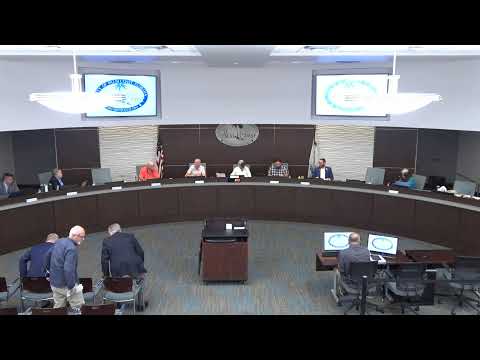
Most times, the planning board — all volunteers — do their thing quietly and unnoticed. This time, though, they earn rock star status. Here are highlights…

So was this whole thing just a scam to let developers build whatever they want out west? Maybe so. But it could be even worse than that, because it could let the property owner walk away from real, contractual commitments made to build an actual community — not just money, but the park, the pool, the fire station, the schools.
Here’s what’s actually on the books, straight from the DRIs themselves:
Eighty-five acres of parks and open space at buildout — enough, under the DRI’s own list of allowed amenities, for the tennis courts, ball fields, swimming pools, playgrounds, and community centers a real neighborhood needs. Land the developer had to deed over, not just promise.
A workforce housing requirement with real teeth: at least 5% of every non-age-restricted unit in the Old Brick Township DRI, a 350-unit minimum in Neoga Lakes tied to specific building-permit triggers, both locked in with 15- to 20-year deed restrictions naming the city itself as the enforcer.
A binding school agreement: 1,085 students accounted for, $25,155,556 in 2010 dollars committed to mitigation, paid through a donated school site and impact fees — not a number pulled from thin air, a contract.
A three-acre fire station site, deeded to the city for free, before the end of Phase 1. Not a promise. Land, already transferred.
These aren’t “on the table,” they’re gone.
So what’s next?
The project was pulled from the City Council’s agenda after being rejected in a unanimous vote by the Planning Board, but it’s back on.

August 4, 2026 Business Meeting — Ordinance 1st readings: Western Parcel Annexation (440 Acres), Western Parcel Annexation (6,601 Acres), Westward Expansion Annexation City Owned Property, Western Parcel FLUM, Western Parcel MPD.
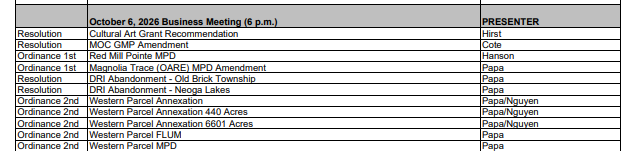
October 6, 2026 Business Meeting — Ordinance 2nd readings on the same five items, plus two resolutions: DRI Abandonment — Old Brick Township and DRI Abandonment — Neoga Lakes.
As commitments, assurances and oversight disappear while the DRIs make their transition into an MPD, suspicion and distrust continue to swirl around the process as the procedural anomalies and oddities pile up.
What’s going on with that?
Stay tuned for our next episode….